
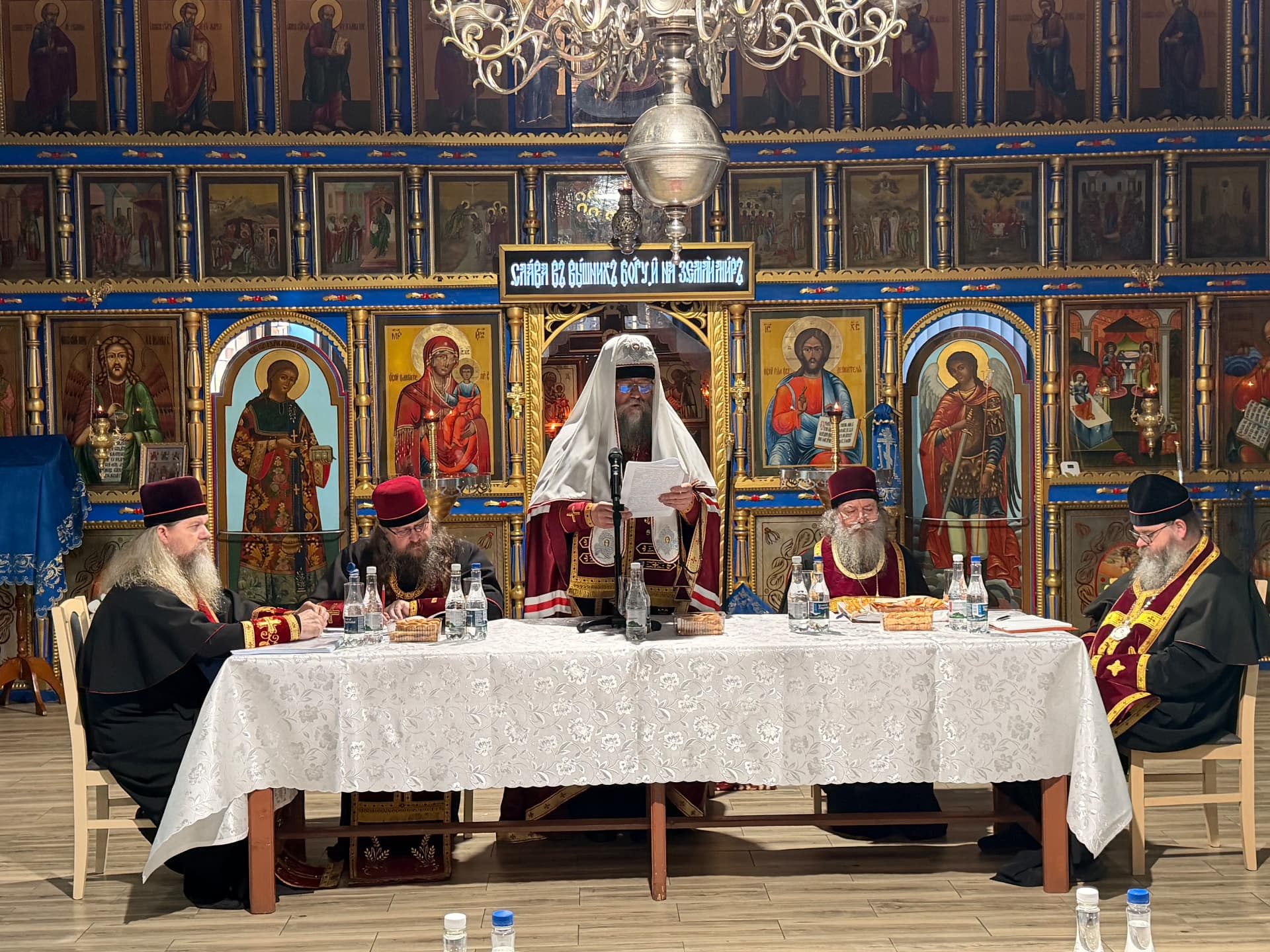
On 9/22 October 2026, the Consecrated Council of the Belokrinitsa Metropolis convened at the Cathedral of the Nativity of the Most Holy Mother of God in Brăila/Hutor, Romania. At the opening of the Council, His Eminence Metropolitan Leontie delivered his archpastoral address on the occasion of the thirtieth anniversary of his episcopal ministry and pastoral service as Primate. The full text of the address is published below.
Full text of the address
OLD RITE ORTHODOX CHURCH – BELOKRINITSA HIERARCHY
O Lord Jesus Christ, Son of God, have mercy on us.
ARCHPASTORAL MESSAGE of His Eminence Metropolitan Leontie, Archbishop of Fântâna Albă and Bucharest, Metropolitan of All Old Rite Orthodox Christians, Primate of the Old Rite Orthodox Church – Belokrinitsa Hierarchy
To the Consecrated Council of the Old Rite Orthodox Church – Belokrinitsa Hierarchy
On the occasion of the thirtieth anniversary of episcopal ministry and primatial pastoral service
9/22 October 2026 • Brăila
O Lord Jesus Christ, Son of God, have mercy on us!
Most Reverend hierarchs, archbishops and bishops, most honourable fathers, reverend archpriests and priests, protodeacons and deacons, brethren in Christ, and all members of the Council! First of all, I greet you all with the holy words of the Holy Apostle Paul: Peace and mercy be unto you from the Lord God and our Saviour Jesus Christ. I also greet you on this Thursday of the twenty-first week after Pentecost, on the commemoration of the Holy Apostle James the son of Alphaeus, and on your safe arrival and attendance at this Consecrated Council. With humility before the All-Good Lord God and His Most Pure Mother, and with fatherly love for each of you, I now address the entire Consecrated Council, for we have gathered to consider, in peace and with spiritual discernment, the condition of the Church entrusted to our care, the trials endured by its communities, and the responsibility we bear before God and generations yet to come. We live in times when the world changes with great speed, and we see wars, divisions and suffering; we see separated families, people and nations at enmity, who can no longer find within themselves the strength to listen to one another. But what grieves my heart most of all is that the spirit of discord sometimes enters even among those who are called to bear witness to the peace of Christ. Hasty judgements, harsh words, suspicions and grievances may arise among us; unless healed in due time, they turn into deep divisions.
By the mercy of God, this year marks 180 years since Metropolitan Ambrose joined the Old Orthodox Church of Christ of the Belokrinitsa Concord and the hierarchy of three orders was restored within it, as well as 80 years since the Church was officially recognised by the Romanian state, and thirty years since my calling to episcopal ministry and the placing upon me of primatial archpastoral care. In this year, when thirty years of my episcopacy and service as Primate of the Church are completed, I desire above all to thank you for the prayers, labours and love with which you have accompanied the work of the Church, and to call upon you to look together not only to the past but, above all, to what we are bound to leave to those who come after us. If any good has been accomplished through me, glory for it be to God; but if I have sinned by word or deed, through weakness or through a lack of due care, I ask for the Lord's mercy and the forgiveness of those whom I have grieved. We are Old Rite Orthodox Christians, children of Christ's Church, which has steadfastly preserved the apostolic faith, the decrees of the Holy Councils and the sacred ordinances handed down by our holy forebears. Our predecessors did not seek a new faith; they defended what they had received. For this steadfastness they endured persecutions, imprisonment, humiliation and wandering, and did not abandon prayer or the order of the Church.
Therefore I address the entire Council with an appeal to reaffirm, clearly and without hesitation, the unshakable preservation of the true Orthodox faith, the holy canons and the whole order of divine worship inherited by us. The Apostle exhorts us: “Stand fast, and hold the traditions which ye have been taught” (2 Thessalonians 2:15). For us, these words are not merely a reminder but an obligation. The holy services are not a human institution which each generation is free to change according to the tastes of its own time, especially the Church Slavonic language in which our forebears prayed, sang and handed down sacred books. For our Church, Church Slavonic is not an ornament of the past, but the language of the holy services and a living bond between generations. Therefore I consider it necessary to preserve Church Slavonic steadfastly in the celebration of divine services and not to permit its replacement with other languages in the liturgical practice of our Church. At the same time, we are obliged to preserve our native language, in which our parents spoke to their children and in which family history, hymns, customs and the memory of our forebears were passed down.
In connection with what has been said, I ask that we consider the use of technical devices in the holy church during divine services. The holy altar is no place for experiments, and the church is neither a hall nor a theatre in which prayer may be replaced by artificial means. During the celebration of the holy services, liturgical books must not be replaced by telephones and screens; live chanting at the kliros must not be replaced by sound recordings, nor should the reading of prayers and liturgical actions be reshaped according to the possibilities of ever-changing technology. I call upon the archpastors, pastors, readers, ustavshchiks and singers to preserve and use the church books, the living human voice, prayerful labour and reverence. A person entering the holy church must leave the noise of the world beyond its threshold and enter a place of prayer, a quiet and holy refuge.
The discord that at times disturbs life in our Church causes me particular sorrow: discord between brethren, between families and communities, and even among the ministers of the Church. Too often we have begun to speak much and listen little. We hasten to justify ourselves, to object and to judge another before understanding what he says and what pain he carries in his heart. Sometimes disagreements that could be resolved through humble conversation turn into grievances lasting many years. How can we pray for the peace of the whole world if we refuse to seek peace in our own parish or family? How can we speak of unity in the faith if we allow ourselves to despise one another? When living faith grows weak, when a person ceases to have the fear of God before him, love of power, which is the mother of heresies, ambition for honours, the striving for pre-eminence, envy and the desire to overcome one's neighbour increase. Then enmity begins to be regarded as a natural thing, and reconciliation as weakness. The Saviour gave us the sign by which His disciples will be known: “By this shall all men know that ye are my disciples, if ye have love one to another” (John 13:35). I call upon each person to examine his conscience, put an end to enmity, refrain from spreading divisive words and not harbour a desire for revenge in his heart. Where there are disagreements, they must be examined and corrected according to truth and church order, but they must never become grounds for hatred. Those who reconcile do not lose honour, but gain peace. And peace founded upon truth becomes one of the strongest witnesses to the faith.
After thirty years of episcopal ministry, I understand ever more deeply how short human life is and how quickly the things about which we worry so greatly pass away. We shall take with us neither ranks, nor wealth, nor offices, nor victories over those with whom we disputed. Before God we shall bear only responsibility for the deeds, words and souls entrusted to us. I often think of those who served before us: of the priests who preserved the faith and divine worship in times of persecution, of the monks who kept vigil in prayer, of the parents who taught their children the faith, and of the elders who ended their lives with the name of the Lord upon their lips. They left us not only books and churches, but a duty and an example. If we preserve the walls but fail to preserve the faith, we shall lose what is most important. Therefore I call upon you not to squander the years granted to us in endless disputes, condemnation of our neighbours, or struggles for things that pass away. Let us correct that in which we have sinned, strengthen every good thing we have received, and pass on to our children a living faith, unchanging in doctrine and church order, yet working through love.
My beloved archpastors, pastors, brethren and all members of the Council, in the name of Christ's love I ask you to maintain peace among yourselves, to forgive one another and not to allow human weaknesses to overcome what unites us. Let us abide in good accord and in shared responsibility for the flock entrusted to us, whose faithful expect from all of us, above all, prayer, instruction and a pure example. Let us preserve as sacred what we have received: the faith, the canons, Church Slavonic, the sacred order of divine services, chanting, traditional dress, our native language and the pious customs of our forebears. But alongside all this, let us preserve mercy, patience, harmony, humility and love, without which Christian life is fruitless. Let us not allow the name of our Church to be associated with endless disputes, ambition or material interests; rather, let it be associated with steadfastness in the truth and the peace of Christ. May everyone who enters our church encounter worship conducted with reverence and according to the order of the holy Church; and upon leaving the church, may they carry in their hearts hope, instruction and the strength to live more fully as Christians. Thus shall we truly bear witness that we have remained children and continuators of those who sacrificially and lovingly preserved the Orthodox faith.
I conclude this message by raising my prayer to our Lord Jesus Christ, the Great Shepherd of our souls, that He may enlighten the minds and hearts of all those assembled at this Consecrated Council, that it may be conducted fruitfully, peacefully and calmly; that He may deliver us from pride, confusion and division, strengthen us in the ancient Orthodox faith, and grant us wisdom to preserve what we received from our holy forebears; that peace may return among people at enmity, wars may cease, the suffering may find consolation, and no child of the Church may remain without the support of prayer. Under the holy protection of the Most Holy Mother of God and through the prayers of all the saints, may we remain unshakable in the Orthodox faith, unwavering in the observance of the holy canons and the ordinances of our fathers, yet united in love and mercy. And when the Lord calls us from this life, may He deem us worthy to pronounce humbly the words of the Apostle: “I have fought a good fight, I have finished my course, I have kept the faith” (2 Timothy 4:7). I ask you all and implore you with fatherly love not to betray the faith we have received, not to abandon the order of our fathers, not to forget human souls and not to lose love for one another. May the God of peace and love be with us all, now and ever and unto ages of ages. Amen.
With archpastoral love and blessing,
Humble† LEONTIE Archbishop of Fântâna Albă and Bucharest, Metropolitan of All Old Rite Orthodox Christians, Primate of the Old Rite Orthodox Church – Belokrinitsa Hierarchy Brăila • 9/22 October 2026